Jul 13 – St Henry the Good (972-1024): Holy Roman Emperor
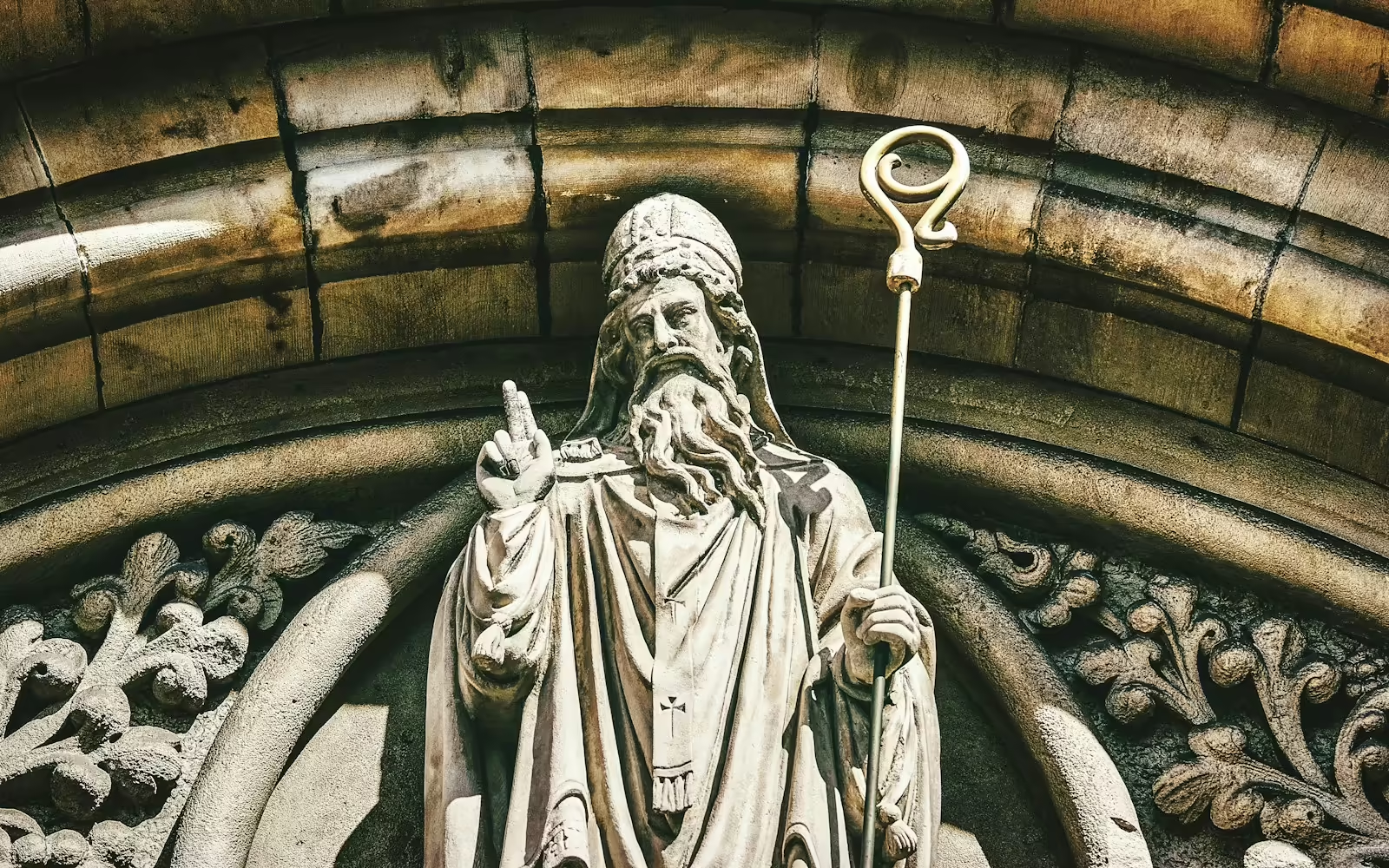
Summary: Henry, born of royalty, was educated at the cathedral school of Hildesheim. He was wise, prudent and never grasping. He built monasteries and endowed dioceses. He threw his weight behind many Church reforms in Germany especially priestly reform. Pope Benedict VIII crowned him and his wife Holy Roman Emperor and Empress in Rome in 1014.

Patrick Duffy records his story.
Early life
Henry was born in 972, the eldest of a family of four children of Henry the Quarrelsome, Duke of Bavaria and Gisella, daughter of Conrad, King of Burgundy. As his father had rebelled against two previous emperors, he spent a lot of time in exile, so Henry was brought up by St Wolfgang, bishop of Ratisbon (Regensburg) (972-994). Later he was educated at the cathedral school of Hildesheim and would probably have thought of becoming a priest.
King in Germany, Italy
However, when his father died in 995, Henry succeeded him as Duke of Bavaria. In January 1002 his cousin Otto III, who had become Holy Roman Emperor, died in Rome. Henry, who was on his way to Rome to help him, got control of the insignia of office and, despite strong opposition from other candidates, was able to secure his own election through the influence of St Willigis, archbishop of Mainz, who then crowned him King of Germany.
Church Reformer

Military and Christian expansion
He waged campaigns first against Arduin of Ivrea and the Lombards in northern Italy; then against the Slavs in Bohemia and Moravia. He also moved against Boleslaus I of Poland, allying himself with St Stephen, the first king of Hungary, who married Henry’s sister, Gisella. Henry insisted on his troops praying and receiving Communion before going into combat and his military advance also brought an expansion of Christian culture.

In 1014 Pope Benedict VIII crowned him and his wife Cunegund of Luxemburg Holy Roman Emperor and Empress in Rome. He was the first to receive the golden orb, inlaid with pearls and topped by a cross, a symbol of the imperial dignity. Henry, dignified by the many honours, gave the orb to St. Odilon, Abbot of Cluny, who was present at the ceremony so that those symbols would be conserved at the Monastery of Cluny.
In 1020 Pope Benedict VIII came to Bamberg where he consecrated Henry’s new cathedral there. The Pope then persuaded Henry to make a campaign to counter the growing power of the Saracens and the Byzantine Empire in the south of Italy.
Family
Henry’s brother Bruno became bishop of Augsburg, his sister Gisella married King Stephen I of Hungary and his other sister Brigid became abbess of the Monastery of St Paul in Regensburg. Henry married Cunegund of Luxemburg, but they had no children. The story that he was celibate probably originated as rumours after his death. He and his wife were canonised in 1146.
____________________________
******************************
Memorable Sayings for Today
He who reigns within himself and rules
passions, desires, and fears
is more than a king
~ John Milton ~
******************************
Summary: Chilean born Saint Teresa of the Andes (1900–20) lived only twenty years, yet in that time she showed an intense love of life and of God. She was canonised by Pope John Paul II in 1993. She is the first Chilean saint.
Patrick Duffy tells her story.
Baptised “Juanita”

Love of horse-riding
Juanita loved going to Chacabuco during vacations and very early learned to ride a horse. Often she would ride through the estate up to the beginning of the Andes Cordillera. Juanita’s brothers and sisters were: Lucita, Miguel, Luis (Lucho), Juana (who died a few hours after birth and whose name was given to Juanita), Rebeca and Ignacio. Juanita was particularly close to her brother Lucho and her younger sister Rebeca.
School days
From 1906 Juanita attended a school run by the Sacred Heart Sisters of St. Madeleine-Sophie Barat in Santiago. She was not an easy character. She was proud, self-centred, stubborn, didn’t like to obey, got angry easily (her brothers liked winding her up!) and would cry for nothing.
Juanita wanted to receive her first communion, but as she was too young she learned how to make communions of desire. In preparation for her first communion, she began to acquire extraordinary virtue expressing her love for life and for God through her actions. Her brother Lucho taught Juanita how to pray the Rosary. Both made the promise to pray it every day, a promise Juanita kept until her death (only one time, she writes, being very small, she forgot). “From that time on, one can say that Our Lord took me by hand with the most holy Virgin.” Eventually Juanita received first communion on September 11, 1910, in Santiago when she was ten.
The Story of a Soul
In 1914 Juanita read for the first time The Story of a Soul by Thérèse of Lisieux (who was not yet beatified) and it made a lasting impression on her. For several years, approaching December 8, Juanita became seriously ill. At this time she had appendicitis surgery and at the same time began to feel Christ was calling her to give herself totally to him and become a Carmelite. During the year 1915 she became a boarding student with her sister Rebeca at Sacred Heart High School.
At boarding school
It was hard for her to leave her family house since she was very attached to them. She understood, however, that the Lord was preparing her for the great separation when she would enter the Carmel. And she saw that school enabled her live a fervent Christian life.
Although she was not an exceptional student, she dedicated herself totally to her studies, including to topics she did not like (such as physics and chemistry) in order to please Jesus and her parents. She liked also to help poor and less-gifted students.
Helping others
It was in this same year (1915) that she met in the street a child in rags hungry and shivering with cold. She introduced him into her house, gave him to eat and asked him where he lived. She discovered that the child was living in a slum in Santiago’s suburb. She visited his family and until her entrance into Carmel in 1919, took care of him, calling him Juanito, having him eat in her family house and giving him clothes from her brothers. She even organised a raffle giving her own watch as the prize so as to earn money to buy shoes for Juanito. At this time also she made a private vow of chastity, promising not to have any other spouse than Jesus Christ.
During her holidays in Chacabuco, she carried on an apostolate among the farmers’ families, gathering people for the missions, teaching catechism to the children, playing with them, organising a choir.
Loss of Chacabuco
In 1917 due to bad management by Juanita’s father, the Chacabuco estate was sold and the family had to adopt a more modest way of life. Juanita saw in this painful event a providential call to detach herself from earthly goods. At this time also she became a Child of Mary with whom she developed a strong spiritual bond.
Contact with Carmel
In September 1917 she contacted the Carmel of Los Andes for the first time and was convinced that was where God wanted her.
In August 1918 she left Sacred Heart School to substitute in the family house of her elder sister Lucia, who just got married. She dedicated herself to her task and accepted any sacrifice for her family’s happiness: “I did not believe that family life was a life of sacrifices. This helped me to prepare myself for religious life.” Her brother Lucho called her “the jewel of the house”.
While having a very intense spiritual life, Juanita lived as a lively young girl of her time. She liked to be with her family and friends. She enjoyed sport, especially swimming (in which she excelled) and tennis which she played with enthusiasm. She enjoyed the beauty of the sea and of the mountains. Although she had poor health, she was always in good spirits and joking.
In January 1919 for the first time she visited the Carmel of Los Andes and was sure that was where God was calling her. She wrote to her father asking his permission to enter Carmel. He was deeply moved, and in tears granted her wish. Juanita then felt great joy in that she was able to dedicate herself totally to Christ and at the same time great suffering because she was leaving her family she loved so much.
Carmel of Los Andes (1919-1920)
On May 7, 1919, Juanita entered the Carmel of Los Andes and took 
With the permission of her prioress, who understood that the new postulant was an exceptional soul, Teresa began intense letter-writing activity, especially to her friends, many of whom later joined Carmel. On October 14, 1919 she received the habit, in the presence of her family and of many friends. All were impressed by her radiating joy.
Approaching death
In the first days of March, 1920, Teresa told the confessor that she had only one month more to live on earth. She asked him for permission to do extraordinary penances. The confessor wondered how she could know the time of her death and told her to be satisfied with observing the Carmelite rule with perfection. Teresa became severely ill and although she knew it would lead her to death, she continued to take part in all the spiritual exercises of Lent, including the rigorous fasting.
On Good Friday, April 2, 1920, she began her way of the cross following Christ. She spent many hours in prayer in the choir. The sisters noticed that she had a burning fever and told her to go to bed.
Several doctors examined her and diagnosed an advanced typhus, but they could not bring about any lessening of her fever. On April 7, Teresa made her profession, a custom allowed for a novice in danger of death. After great physical and spiritual sufferings, she died on April 12, 1920.
Burial, influence and canonisation
Teresa’s burial took place two days later. The sisters and the family were surprised to see the convent chapel flooded by people who, although they did not know Teresa, came to venerate the little saint who had just died.
Her younger sister Rebeca entered the Carmel of Los Andes in November that year, convinced that God had called her to substitute for her sister in the community and continued faithfully in her vocation until death in 1942.
Pope John Paul II beatified Teresa in Santiago de Chile in 1987 and canonised her in 1993. She is the fourth Saint Teresa in Carmel, along with Saints Teresa of Avila, of Florence and of Lisieux.
____________________________________
******************************
Memorable Sayings for Today
Being a woman means you’re a part of a sisterhood that spans across time and continents. How you treat a “sister” or a “mother”
is how you encourage them to treat you and other women,
so let it be in a manner of encouragement and respect.
~ 1 Timothy 5:2 ~
******************************
____________________________